
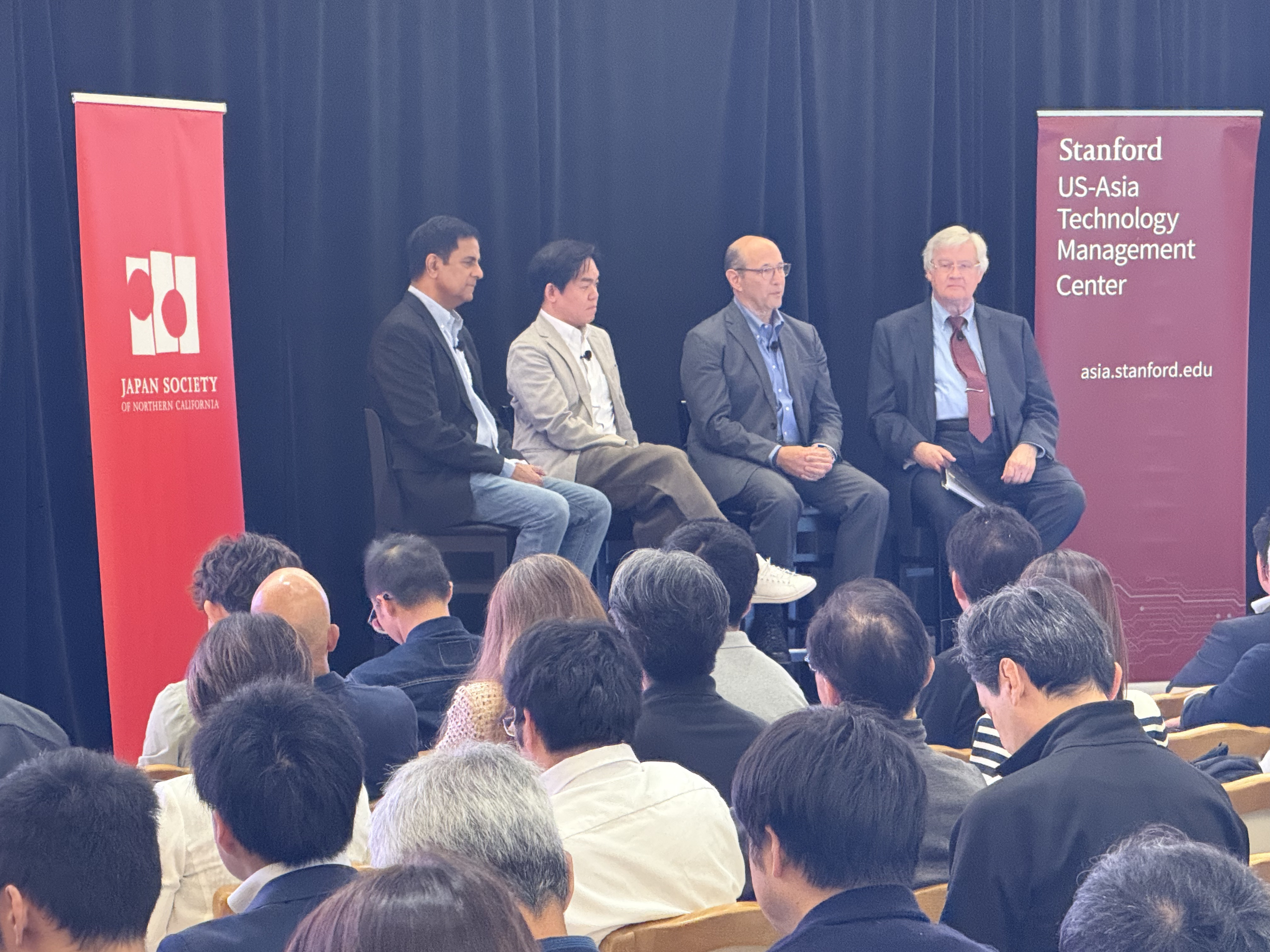
The afternoon of this year's Innovation Symposium, hosted by the Japan Society of Northern California at Stanford, featured two very different AI companies. One is a fast-rising American frontier lab. The other is a small, deliberately unconventional Japanese startup. Both received the program's top honor, and both made a related argument: that the future of AI depends less on the size of a model than on trust and sovereignty.
The award
The centerpiece of the afternoon is the SunBridge John Thomas Emerging Leader Awards, a selective honor for later-stage, high-growth companies that are becoming leaders of their industries. The award has a notable track record. Past US recipients include Tesla Motors in 2011 and Zoom in 2018. It is named for its sponsor, the investment group SunBridge, founded and chaired by Alan Miner, one of the awards program's original architects, and for the late John Thomas, a longtime vice chair of the Society who helped build the program.
This year the Emerging Leader Award for the United States went to Anthropic, and the award for Japan went to Sakana AI.
Anthropic: adoption at the speed of trust
Accepting on Anthropic's behalf was Jeff Bleich, the company's General Counsel and a former US Ambassador to Australia and White House special counsel in the early Obama administration. He treated the recognition mainly as a marker of how quickly Anthropic's relationship with Japan has developed. "We're a relatively young company, and our relationship with Japan is also young," he told the room, "but we seem to sync up very well."
His main point was that technology alone doesn't determine outcomes. Adoption does, and adoption "moves at the speed of trust." The exponential progress of AI only becomes a broad benefit if society's ability to trust and absorb it keeps pace. That idea organized what he called his "laundry list" of the past eight months in Japan:
- A memorandum of cooperation with Japan's AI Safety Institute, signed in October 2025 alongside the opening of Anthropic's Tokyo office, its first location in the Asia-Pacific region. The focus was evaluation methodology and the science of measuring what AI models can and can't safely do.
- A hands-on Claude workshop for roughly 50 ruling-party lawmakers and their staff, held at the National Diet members' offices, meant to help the people writing policy understand the technology.
- Adoption of Claude in real government workloads through a project led by Japan's Digital Agency.
- A run of enterprise partnerships announced within five weeks. NEC became Anthropic's first Japan-based global strategic partner in April, rolling Claude out to some 30,000 employees. Fujitsu adopted Claude as "customer zero" alongside its own AI technology. Rakuten became a flagship early adopter, using Claude for autonomous coding. A further partnership with a major Japanese infrastructure group, a workforce of roughly 290,000, added a jointly created AI deployment center and a training program for over 100,000 employees.
Bleich credited the pace to culture as much as strategy. He described a company that stays humble, keeps its focus on the mission, and doesn't fight over credit, and he closed by looking ahead "to the next eight months, the next eight years, and the next 800 years."
In the fireside chat that followed, moderated by Richard Dasher, director of Stanford's US-Asia Technology Management Center, Bleich returned to the trust theme. He described how a recent, unexpectedly capable model led Anthropic to slow down and socialize it with government and cyber-defense partners before release. He compared building AI to jazz rather than a scored orchestra: a set of core principles, adaptable people, and a lot of trust about when to lead and when to step back.
Sakana AI: sovereignty as a design principle
Where Anthropic argued that adoption runs on trust, Sakana AI's co-founder and chairman, Ren Ito, argued that access runs on sovereignty, and he declined to treat Anthropic as a rival. "You may feel there is a huge competition going on in the AI space," he said, "but we don't see the other AI companies as competitors. We are friends trying to make AI as great as possible."
Founded at Christmas 2023 with three people, Sakana chose not to raise and spend hundreds of millions on compute for ever-larger models. Its approach instead is model orchestration: building small models of its own while routing each task to whichever of hundreds of underlying models, open-source or proprietary, is best suited to it. Ito described the payoff in the language of national AI strategy: better performance, lower token cost, and supply-chain diversification. When France, the UK, or Japan invoke sovereignty, he said, the real question isn't only whether you own your own model. It's whether you have reliable, working access to the models you depend on. Orchestrating many models means no single provider's absence can knock you offline, which makes exclusion pointless. As he put it, "Why don't we coexist together?"
Sakana's second bet is filling the gap between the model layer and the application layer, capturing the tacit, "tribal" knowledge that a frontier model plugged into a corporate database still lacks. Citing the widely discussed MIT finding that the large majority of enterprise AI pilots fail, Ito described that bridging work as the difference between a proof of concept and a working solution. The company is applying it with Japanese banks and, more recently, the Japanese defense establishment.
Presenting the Japan award, and joining Dasher and the two honorees for the fireside conversation, was Shri Dodani of Global Hands-On VC, standing in for Alan Miner. He offered an investor's read on what separates a genuine category leader from a merely successful company: a hungry team with deep domain expertise, chasing a market that doesn't yet exist.
The takeaway
Two companies from two countries left the stage with the same conclusion. Whether you call it trust or sovereignty, the next phase of AI will be won less by whoever builds the biggest model and more by whoever earns the confidence, and secures the access, to put it to work.
#AI · #Trust · #Sovereignty · #Anthropic · #SakanaAI · #Japan